
Lead Work London — Specialist Roofing Leadwork
Covers Of London provides specialist lead work across London and the South East. From lead flashing repairs on Victorian terraces in Hackney to full lead roof replacements on period conversions in Islington, our team handles every aspect of roofing leadwork — properly detailed, correctly coded, and built to last decades rather than years.


30+
YEARS IN THE TRADE

3,500+
PROJECTS COMPLETED

24hr
EMERGENCY CALL-OUT

10yr
WORK GUARANTEE
Lead is not a material that forgives poor workmanship. Get the detailing wrong — the laps, the fixings, the allowance for thermal movement — and it will crack, lift, or split within a few years. We see the consequences of bad lead work on a weekly basis: mastic slapped over gaps that should have been dressed, code 3 lead used where code 5 was needed, sheets fixed so tightly they had no room to expand in summer heat.
Our lead workers are time-served tradespeople. They understand how lead behaves across the seasons — how it stretches in July and contracts in January — and they detail every joint, welt, and step accordingly. That is what separates lead work that holds for five years from lead work that holds for fifty.
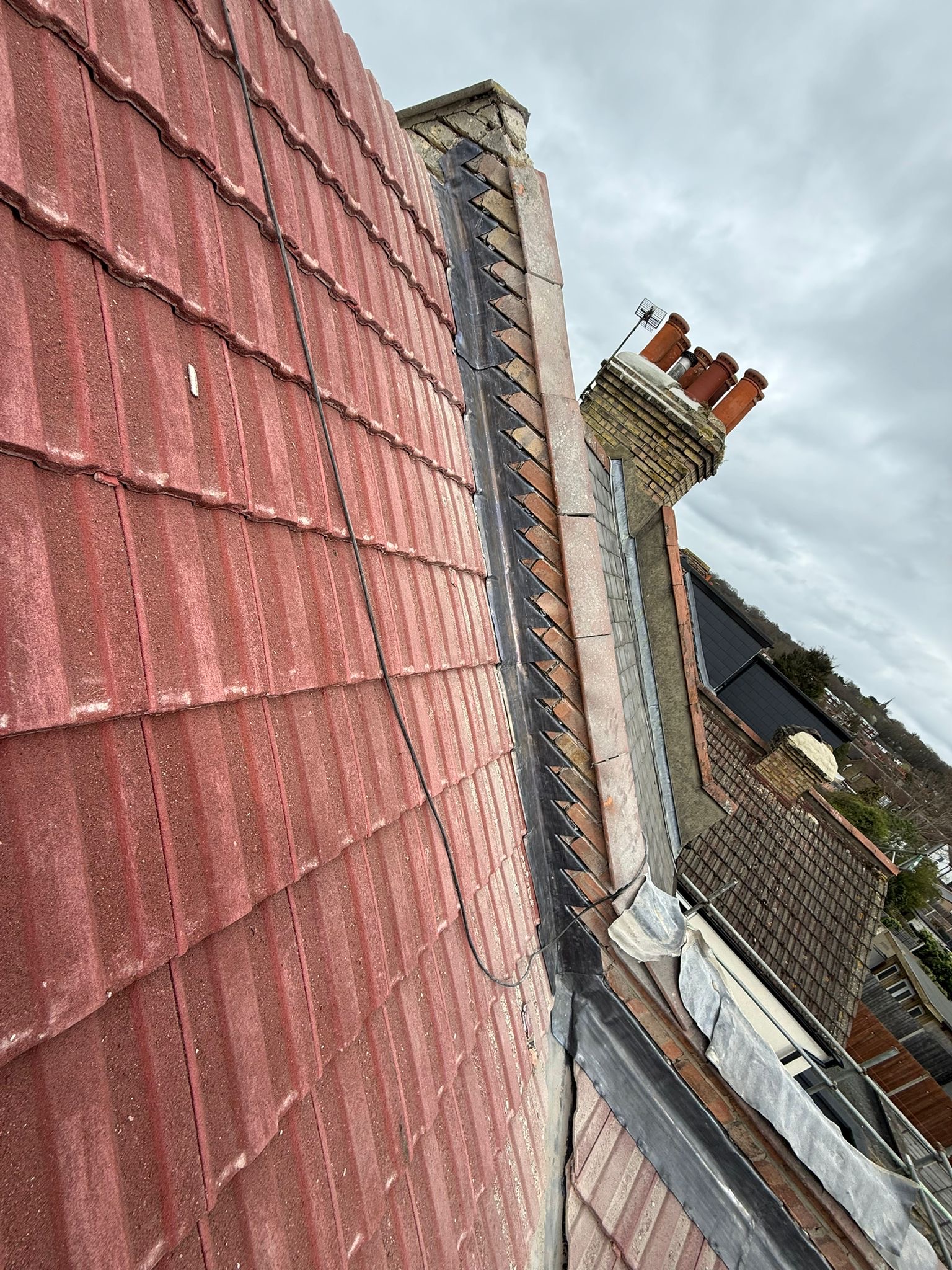
Where the lead is difficult to inspect from ground level, or where the property is three storeys or more, we use drone roof surveys to capture detailed imagery before we quote. It means we can show you precisely what needs doing and price the job accurately, without the cost of scaffolding just for a look.
LEAD WORK SERVICES
Lead Work Services We Provide
We carry out the full range of roofing leadwork — from a single section of failed flashing to a complete lead roof installation. Every job is detailed in accordance with the British Standard Code of Practice (BS6915) and uses the correct lead code for the application.
Lead Flashing Repairs and Replacement
Lead flashing seals the joints where a roof meets a wall, chimney, or adjoining structure. When it cracks, lifts from the mortar chase, or gets bodged with mastic by someone who should have re-dressed it properly, water finds its way in. We replace step flashing, apron flashing, chimney back gutters, and abutment flashings using the correct code lead for the situation. If a previous repair has been done badly, we strip it back and start again.
Lead Roofing for Bay Windows and Dormers
Bay windows and dormer roofs are among the most common lead applications on London properties. The roof covering, the cheeks, and the junction details all need to work together as a single watertight system. We install flat and pitched lead coverings on bay tops, dormer cheeks, and porch canopies — always on a suitable substrate with the correct underlay to allow moisture control and thermal movement. Properties across Hackney, Stoke Newington, Islington, and Camden are particularly rich in Victorian and Edwardian bays that need periodic lead renewal.
Lead Valleys and Gutters
Valleys channel large volumes of rainwater and are one of the first places a roof will fail if the lining is substandard. We install and replace lead valley linings in code 5 lead, with welded joints at outlets and correct expansion allowances at every step. Lead gutters — both perimeter and internal box gutters — are formed with the right falls and outlet positions to prevent standing water. A correctly installed lead valley or gutter will outlast the tiles and slates around it.
Flat Sheet Lead Roof Coverings
Sometimes a flat roof calls for something better than a membrane. Where longevity matters — or where the property demands it — flat sheet lead is the right answer. We install flat lead roofs in bays separated by timber rolls, using code 5 lead as standard for roof coverings. The sheets are sized to manage thermal expansion, and we apply patination oil on completion to prevent staining on surrounding brickwork during the first few months. Done well, a flat lead roof will serve your property for a century or more.
Lead Welding and Specialist Detailing
Certain joints and junctions call for lead welding rather than mechanical fixings or bossing. We carry out lead welding on gutter outlets, complex valley intersections, and bespoke details where a lapped or dressed joint would not perform adequately. Our team also handles lead cladding on dormer cheeks, lead capping on parapets and ridges, and lead soakers behind slate and tile courses. Each of these applications has specific requirements for lead code, fixing method, and movement allowance — and we get them right.
WHY LEAD
Why Lead Remains the Preferred Material for London Roofs
There is a reason lead has been used on British roofs for centuries. No other material handles thermal movement as gracefully. London temperatures can swing from below freezing in February to well above 30°C in August — and lead accommodates that expansion and contraction without cracking, provided it has been detailed and fixed correctly.
It is also extraordinarily durable. A properly installed lead roof covering will last 60 to 100 years, and there are examples across London of lead that has survived far longer than that. Compare this to a felt flat roof (15–20 years if you are lucky) or even a GRP system (25–30 years under good conditions), and the value becomes obvious.
Lead is fully recyclable. Old lead removed during replacement is returned and reprocessed. In a city where planning requirements and conservation area rules often demand traditional materials, lead gives you compliance and performance in one.
But all of that depends on the installation. Lead that has been improperly fixed — over-nailed, under-sized, or installed without room to move — will fail far sooner than it should. That is why the person doing the work matters as much as the material itself.
UNDERSTANDING LEAD CODES
Lead Codes — Choosing the Right Thickness
Lead sheet comes in numbered codes that indicate thickness. The code you need depends on the application, and using the wrong one is a common cause of premature failure.
Code 3 is the thinnest and is used for small details and soakers — thin strips that sit behind individual tiles or slates to form a weathertight seal. Code 4 is the most widely used grade. It suits standard flashings, small gutters, and general-purpose applications where the lead is not bearing significant water loads or spanning large areas. Code 5 is heavier and is the correct choice for valley linings, larger gutters, flat roof coverings, and any application where the lead will carry concentrated water flow or be subject to foot traffic.
We see a surprising number of repairs where the wrong code has been used — code 3 on a valley lining, for instance, which was never going to hold up. Choosing the right code from the outset is not optional. It is the difference between lead that performs for decades and lead that splits within five years.
REPAIR OR REPLACE
When to Repair and When to Replace Lead
Not all damaged lead needs to come off. A single split in an otherwise sound sheet can often be repaired with a lead-welded patch. A section of flashing that has pulled from the mortar chase can be re-dressed and re-pointed without replacing the whole run.
But there are situations where patching is false economy. When the lead has become thin and fatigued across a wide area — you can tell because it feels almost papery — it has reached the end of its working life. When multiple splits keep appearing in the same area. When the original installation was the wrong code, or the sheets were oversized and have been fighting thermal movement for years.
In those cases, replacement is the right call. We will always tell you which option makes more sense for your property and your budget. We would rather do one proper job than patch the same section three times over two winters.
Customer Reviews
What our customers say
Service Areas
Areas We Cover for Lead Work in London
We are based in Hackney and carry out lead work right across London, into Essex, and throughout Hertfordshire. Whether your property is a Georgian townhouse in Westminster or a 1930s semi in Woodford, we know the housing stock and the planning rules that apply.
Hackney
Islington
Camden
Tower Hamlets
Haringey
Waltham Forest
Newham
Southwark
Westminster
Barnet
Enfield
Cheshunt
Woodford
Loughton
Romford
Bromley
All London Boroughs →
FAQS
Lead Work London — Frequently Asked Questions
How long does lead roofing last?
When correctly specified and installed, a lead roof covering will typically last between 60 and 100 years. Some examples in London have been in place for considerably longer. The key factors that determine lifespan are the lead code used, whether the detailing allows for thermal movement, and whether periodic inspections identify minor issues before they become serious. Lead that is over-fixed or undersized will fail much sooner.
How much does lead work cost in London?
Costs depend on the scope of the work, the lead code required, and access arrangements. Replacing a short run of lead flashing might cost a few hundred pounds. A full lead bay window roof or dormer covering will be more, and a large flat lead roof more again. We provide free surveys and detailed fixed-price quotes so you know the cost before anything starts. There are no hidden charges.
What is the difference between code 4 and code 5 lead?
The code number refers to the thickness of the lead sheet. Code 4 (1.80mm) is the standard grade for most flashings and smaller applications. Code 5 (2.24mm) is heavier and is specified for valley linings, larger gutters, and flat roof coverings where the lead will carry concentrated water loads or be walked on during maintenance. Using the wrong code is a common cause of premature failure.
Can failed lead flashing be repaired rather than replaced?
In many cases, yes. A localised crack, a single section that has pulled from the mortar chase, or a small area of lifting can often be repaired without replacing the entire run. We assess the overall condition of the lead during our survey and will recommend repair where it makes sense. If the lead is thin, fatigued across a wide area, or was originally the wrong code, replacement is the better option.
Do you offer a guarantee on lead work?
Yes. All lead work carried out by Covers Of London comes with a written 10-year workmanship guarantee. We hold full public liability insurance and every member of our team works directly for us — no sub-contractors. If there is ever a problem with work we have completed, we come back and put it right.
Is lead safe to use on residential roofs?
Lead is entirely safe as a roofing material for residential properties. The health concerns associated with lead relate to occupational exposure during manufacture or prolonged contact — not to having it on your roof. We follow HSE guidance on working safely with lead, and the finished installation presents no risk to building occupants. Lead has been used on British homes for hundreds of years and remains approved under current building regulations.
How quickly can you carry out emergency lead repairs?
We aim to respond to emergencies within the hour across London. If a section of lead has been blown off or lifted in a storm, or if a lead failure is causing active water ingress into the property, we will send a team to make the roof safe and stop the water getting in. The permanent repair is then arranged at a convenient time, usually within a few days.
Get a free lead work quote
Whether you need a section of failed lead flashing replaced or a full lead roof covering installed, we are ready to survey your property and provide a detailed fixed-price quote. Most inspections can be arranged within 48 hours.
